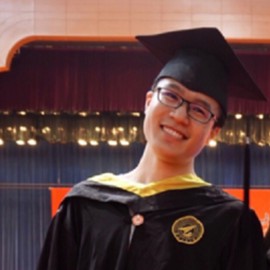
I am now the founder and Chief Scientist of Sea-Land.ai.
I was a PhD student at the Department of Computer Science, University of Toronto. Before that, I graduated as a master student of artificial intelligence from the Zhejiang University CAD&CG National Key Lab ZJULearning Group. I was very fortunate to be advised by Prof. Deng Cai and Prof. Xiaofei He. I was also a research intern at the University of Toronto, where I was very unfortunate to work with Qizhen Zhang, so I decided to quit at last. My research includes machine learning, data mining, deep learning, computer vision, operating system, system programming, and database. I have worked as a system developer in Optiver Shanghai and have interned as a machine learning engineer in Hangzhou FABU, where I was fortunate to work with many colleagues, and in Google, where I was fortunate to work with Jingtao Wang. I was also a software engineer @ DolphinDB Inc, where I was fortunate to work with Davis and Xinjing Zhou, and many colleagues.
MEng in Artificial Intelligence, 2020
Zhejiang University
BSc in Aerospace Engineering, 2017
Northwestern Polytechnical University
Quickly discover relevant content by filtering publications.
Fortunate to work with Davis, Xinjing Zhou, and many colleagues.
Designing and building the storage engine for Time-Series Database, which is extremely efficient both for analytics, writing data, and point-query.
Leading System/DB for AI, add textDB(text search in DolphinDB), vectorDB, and etc.
Maintaining and extending the existing computing engine
Responsibilities include:
Developing the rule-based autotraders.
Improving the machine learning pipeline.
Improving the testing environment for binaries.
Exploring extended application for Tesseract with some development.
Fortunate to work with many colleagues.
Responsibilities include:
This paper introduces FEDDE, a general and efficient framework that addresses data redundancy across clients to facilitate effective federated learning (FL). At its core, FEDDE adopts a hierarchical deduplication architecture where clients first perform local, centralized deduplication and then send minimal records that are only meaningful for redundancy detection to the server for global deduplication. To enable flexible trade-offs between FL training efficiency and the accuracy of the training outcomes, FEDDE proposes two-round approximate deduplication protocols. A set of system optimizations is further applied to reduce deduplication overhead.
Federated learning (FL) has emerged as a popular paradigm for distributed machine learning over decentralized data. Data generated by FL clients is prone to noises. While the impact of data noise on centralized learning (CL) is well understood, there is lack of a systematic study for FL. We fill this gap by presenting an empirical investigation to provide a deeper understanding regarding the impact of data noise on FL. Our study is enabled by NoiseMaker, an open-source and extensible toolkit for the injection of controlled data noises across five diverse data modalities. Our experimental evaluation results reveal that FL is significantly more vulnerable to data noise compared to CL.
This paper establishes that General Relativity and Quantum Mechanics are necessary logical consequences of the Axiom of Finite Information. We introduce a new fundamental constant, i, representing the Information Maximum Transfer Speed, and posit that i > c, where c is the speed of light in a vacuum. By substituting i into the relativistic framework, we demonstrate that the finite nature of i is the primary mechanism preventing infinite information density and logical singularities. Furthermore, we prove that a ‘Theory of Everything’ is precluded by the computational cost of self-reference, and propose the observation of Computational Redshift as a definitive empirical test for the gap between c and i.
We propose a conceptual framework to resolve the dichotomy of the Millennium Prize Problems by categorizing mathematical systems based on their capacity for logical simulation. We distinguish between Class I (Structural) problems (e.g., Poincaré, Hodge, Yang-Mills), which rely on symmetries, conservation laws, and coercivity estimates that constrain degrees of freedom effectively, and Class II (Simulational) problems (e.g., P vs NP, Navier-Stokes), which theoretically possess the fidelity to simulate Universal Turing Machines. While not a formal proof of independence, we argue that Class II problems face obstructions isomorphic to the Halting Problem, inhibiting standard analytic techniques. We posit that the ‘intractability’ of these problems arises because they inhabit a complexity class where asymptotic behavior is determined by generalized computation rather than geometric structure.